Same Drug, Different Tablet: What to Do When Your Quetiapine Refill Looks Nothing Like Last Month's

Photo: NIAID, CC BY 2.0, via Wikimedia Commons
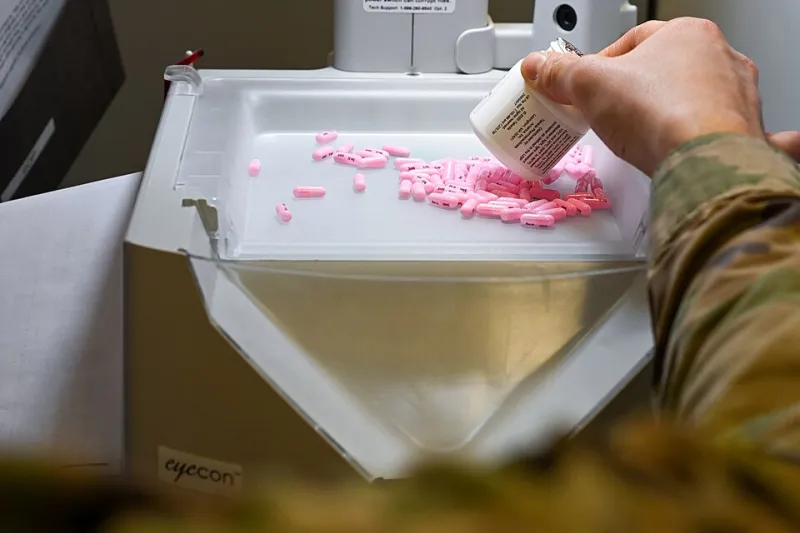
For many patients taking quetiapine, the pharmacy experience includes a quiet surprise: the pills in this month's bottle look nothing like the ones in last month's. Round becomes oval. White becomes peach. The imprint code changes entirely. This is not an error, and it is not necessarily a problem—but it is worth understanding, because for a subset of patients, these switches matter more than the label suggests.
Why Your Pharmacy Keeps Switching Manufacturers
Brand-name Seroquel lost patent protection years ago, and the US generic market for quetiapine is crowded. Dozens of manufacturers produce generic quetiapine, including Aurobindo, Sandoz, Teva, and others. Wholesalers and pharmacies shift between suppliers based on price fluctuations, rebate contracts, and simple availability. Unlike a retail chain deciding which soda to stock, these decisions happen behind the scenes and change frequently.
The result: the same prescription filled at the same pharmacy can come from three different factories over three months. Federal law permits this, and in most cases, the medication performs equivalently.
The Bioequivalence Standard—and Its Limits
The FDA requires that a generic demonstrate bioequivalence to the reference drug, typically meaning the rate and extent of absorption fall within 80 to 125 percent of the brand. That is a wide window. For most medications, most of the time, this variation is clinically meaningless.
But quetiapine is not most medications. It has a short half-life, significant sedation effects that vary with absorption speed, and a narrow therapeutic conversation between benefit and side effects for some patients. Extended-release formulations (quetiapine ER) are particularly sensitive: a generic that releases the drug slightly faster or slower can change how drowsy you feel at 9 a.m. or how well you sleep at midnight. Patient advocacy communities and some psychiatrists have long argued that for certain narrow-window drugs, generic switching should be approached more cautiously.
The Authorized Generic Wrinkle
Here is a detail many patients never learn: an authorized generic is the brand-name drug itself, sold under a generic label by the brand's own manufacturer. If your pharmacy stocks an authorized generic of quetiapine, you are essentially receiving Seroquel with a different name on the bottle. Asking your pharmacist whether your generic is an authorized generic is a legitimate, answerable question—and one of the simplest ways to reduce variability without paying brand prices.
A Tracking Checklist for Patients
If you suspect different generics are affecting you differently, treat it like data collection:
- Photograph every new bottle and pills. Note the manufacturer's name printed on the label.
- Keep a two-week symptom log after any switch: sleep quality, morning grogginess, appetite, mood stability, and any return of the symptoms the drug treats.
- Record timing. If sedation hits harder or fades faster with a new version, write it down with dates.
- Bring the log to your prescriber. Patterns over two or three switches are far more persuasive than a vague sense that "something felt off."
Scripts for the Counter and the Phone
Talking to a pharmacist: "I've noticed changes since my generic manufacturer switched. Is there a way to keep me on the same manufacturer consistently?" Many pharmacies can note a preference in your profile, even if they cannot guarantee it.
Talking to your insurer: "My prescriber believes consistent sourcing is medically necessary. What is the process for a formulary exception or for covering brand-name Seroquel?" Insurers often require documentation of therapeutic failure or adverse effects with two or more generics before approving brand coverage.
When Brand-Name Seroquel Is Justified
There are situations where pushing for brand is reasonable: documented worsening of symptoms or side effects after multiple generic switches, stabilized patients on extended-release formulations where consistency matters most, and cases where an authorized generic is unavailable but the brand's copay assistance or a manufacturer savings program narrows the cost gap. Brand Seroquel is expensive—often several hundred dollars monthly without coverage—so pursue it deliberately, with your prescriber's documentation, rather than as a first resort.
Consistency is not always achievable in the generic era, but it is always worth asking for. Patients who track, document, and speak up get better outcomes than those who assume the pharmacy knows best.